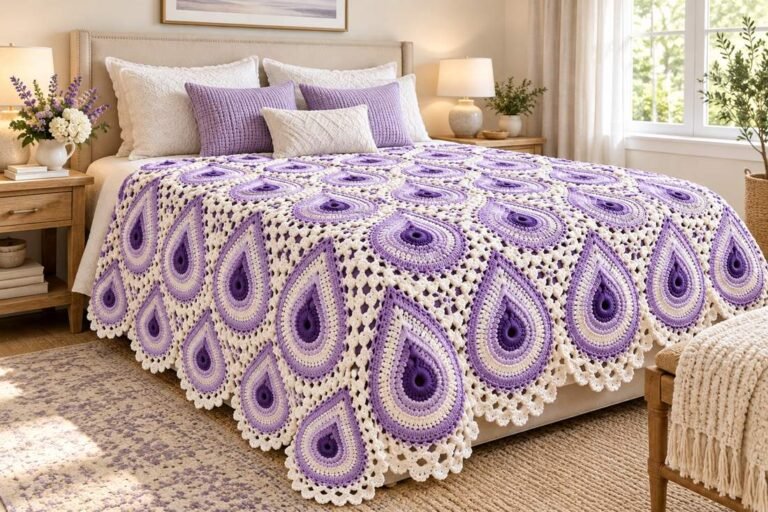
Dusty Blush Crochet Hexagon Bedspread: Motif & Sizing Guide
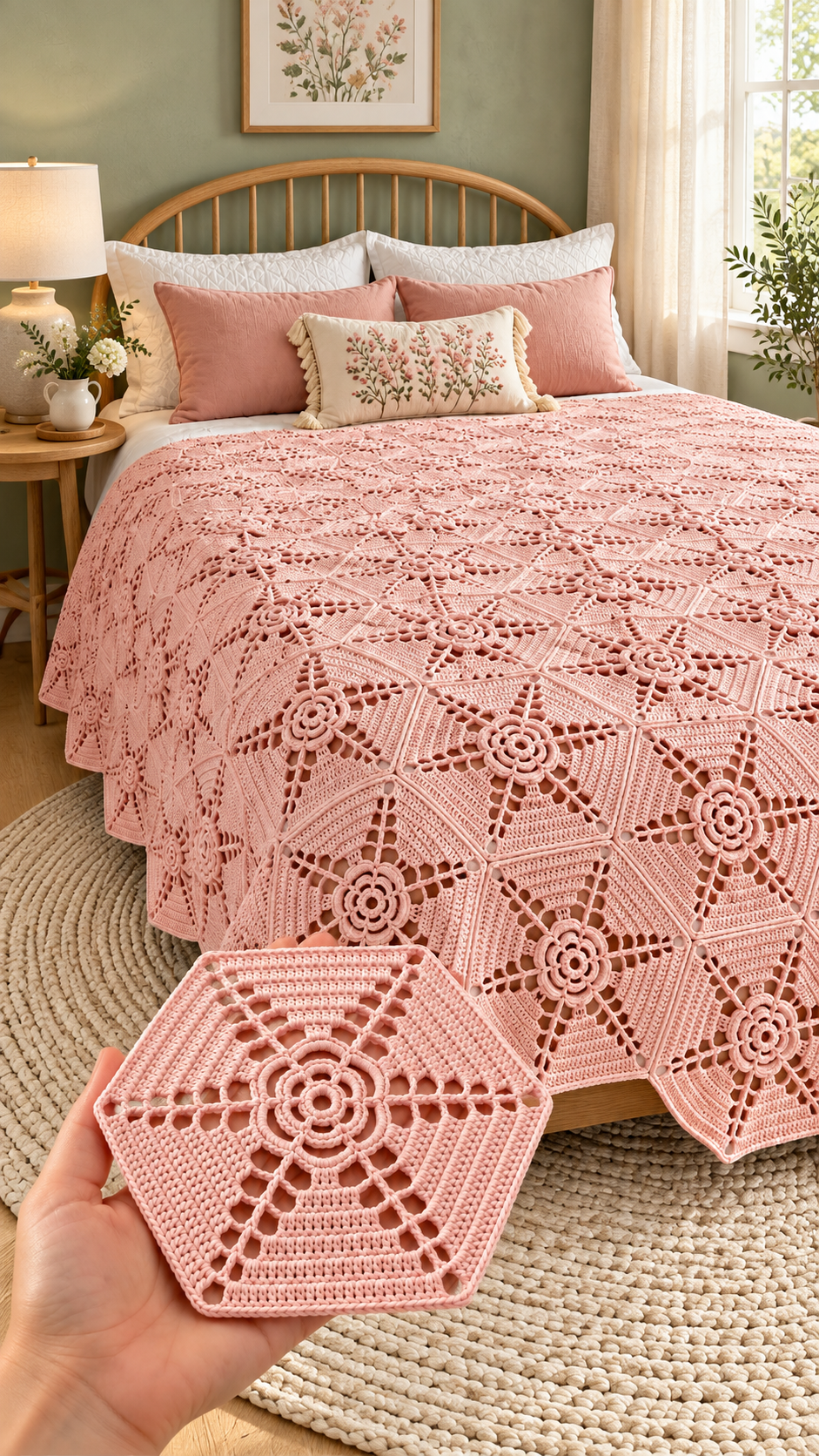
A dusty blush crochet hexagon bedspread brings floral texture, soft color and a handmade focal point to a bedroom. The inspiration image combines six-sided motifs, raised flower-like centers and open lace with sage walls and ivory bedding. This guide explains how to plan that look, choose materials, practice a simpler hexagon, and build a joined cover that suits your own bed.
This is a photo-inspired project guide with an original, simplified solid hexagon practice pattern. It is not the exact floral-lace pattern in the image. The practice motif has a plain center and solid sides; it will not create the pictured flower and openwork. The written pattern has not been physically tested. Make and block a sample before committing to a bedspread.
- Project: a customizable motif bedspread or a smaller decorative throw.
- Practice level: confident beginner familiar with working in rounds; recreating elaborate floral lace requires a separate, complete lace pattern.
- Terms: US crochet terminology.
- Main color: dusty blush, with ivory and sage as optional styling accents.
- Size and yarn quantity: calculate from a blocked, joined sample; no fixed finished size is promised.
- Construction: individual six-sided motifs, joined in offset rows, with a tested edging.
🧶 Yarn, tools and a dusty blush palette
Choose the fabric you want before choosing a hook. Smooth cotton can make stitch texture easy to see, while a cotton blend may give a softer hand or a different drape. Fiber behavior varies: compare the yarn label, wash instructions and a blocked swatch rather than assuming every cotton yarn behaves alike. A full bedspread can become heavy, so a small sample panel is more useful than a single unwashed motif.
- Yarn: smooth yarn in dusty blush from one dye lot, with enough reserve for seams, edging and samples. A DK or sport-weight yarn is a possible starting point for sampling, not a substitute for checking gauge.
- Hook: begin with the size recommended for the selected yarn and adjust after you assess the fabric. Keep the same hook style and size throughout the project.
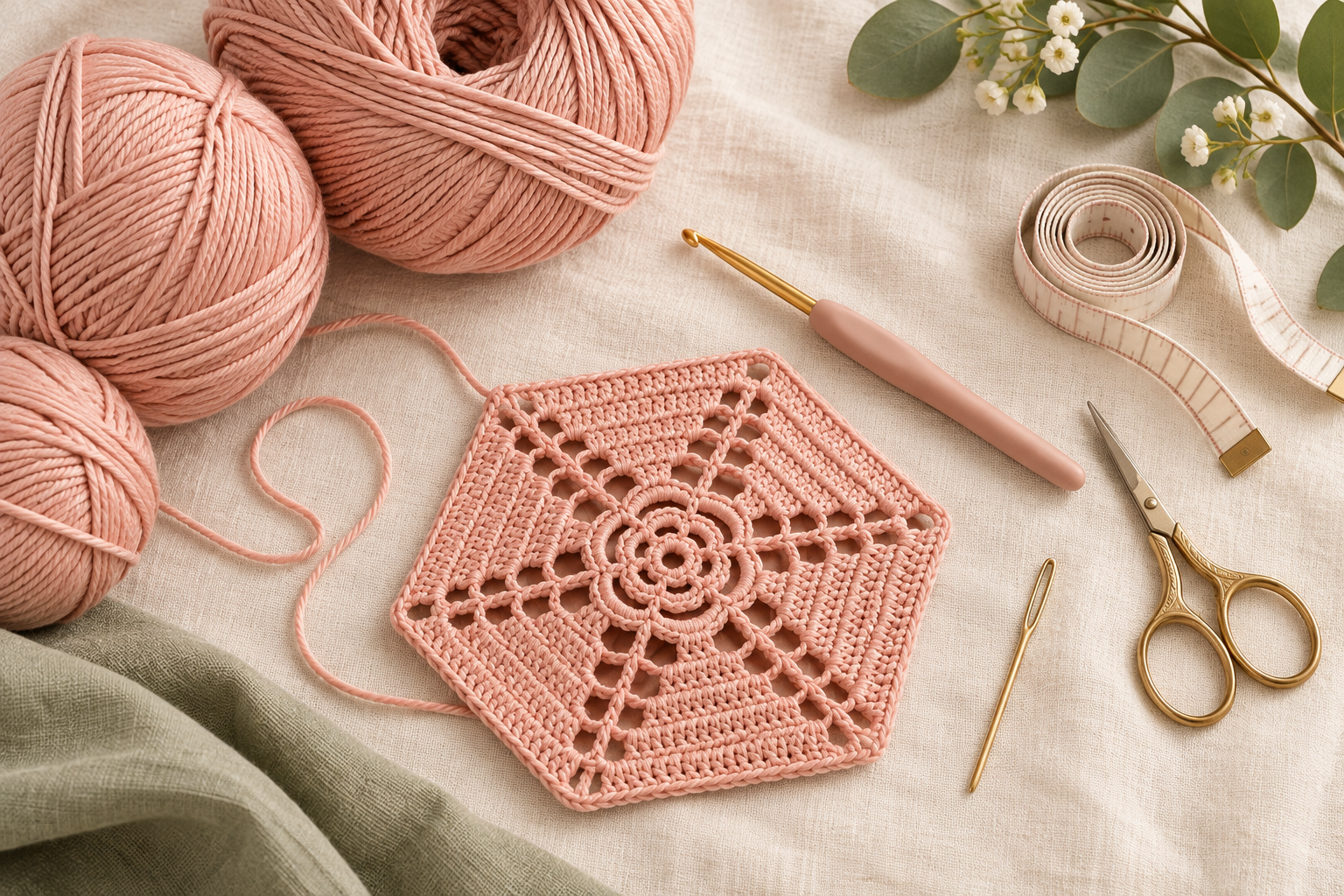
- Tools: blunt tapestry needle, scissors, six stitch markers, measuring tape, and a suitable flat blocking surface.
- Helpful extra: a digital scale to weigh the dry sample panel and estimate yarn use.
Three color combinations to try
Quiet and tonal: use blush throughout, letting the texture supply the contrast. Light and fresh: pair blush motifs with ivory bedding and a narrow ivory edge. Garden-inspired: keep the crochet blush and use sage cushions or a sage wall nearby. Test contrasting joining yarn on a small panel first: a seam that looks subtle on one motif may create a strong grid across a whole bed.
📏 Plan the size before making dozens of motifs
Measure the mattress width and length, then decide how far the cover should hang at each side and at the foot. A bedspread that drapes toward the floor needs a different plan from a light throw placed across the lower half of a bed. Include any fold-over at the head, and measure the actual bed rather than relying on a size label.
- Make a practice motif. Work enough rounds to judge the fabric, then wash and block it according to the yarn label. Let it dry completely.
- Record two dimensions. Measure both the distance between opposite flat sides and between opposite points. These are different on a hexagon; one number alone is not enough to plan an offset layout.
- Join a small panel. Use several motifs in at least two offset rows. Check how the seam changes width, flexibility and the outer outline.
- Mock up the cover. Trace the blocked motifs onto paper or use paper shapes at scale. Arrange full motifs and mark the intended outer boundary. Measure the assembled panel and count the actual shapes needed.
- Choose the edge deliberately. Full hexagons naturally leave a stepped or scalloped perimeter. A straight rectangular edge needs separately designed partial motifs or another filling method; simply adding a border will not fill deep gaps evenly.
Weigh a dry joined sample and divide its weight by the area it covers. Multiply by the planned cover area, then allow extra for the perimeter, sampling and a reserve. This is a planning estimate: motif layout, edge gaps, joins and your tension affect the result.
Hypothetical example: a 50 × 45 cm joined panel weighing 95 g covers 2,250 cm². A 200 × 225 cm cover is 45,000 cm², or 20 times that area. The starting estimate is 1,900 g. Adding a 15% allowance gives about 2,185 g, approximately 22 balls of 100 g. These numbers illustrate the calculation only; they are not the yarn requirement for the pictured bedspread.
📋 US crochet abbreviations
ch = chain; sl st = slip stitch; sc = single crochet; dc = double crochet; st(s) = stitch(es); sp = space; rep = repeat. A group in parentheses is worked into the same indicated space. The Craft Yarn Council abbreviation reference explains these US terms and their differences from UK terminology.
🌸 A simple crochet hexagon practice pattern
This solid motif lets you practice six corners, consistent sizing and joining before choosing an elaborate lace design. It does not include the raised flower, radiating lace or detailed sections in the photographs. If that exact appearance is your goal, use a complete floral hexagon pattern with its own stitch counts and gauge, then apply the planning and assembly advice in this guide.
Pattern notes: work in joined rounds without turning. The beginning ch 3 counts as one dc. Each ch-2 space is a corner. Do not count a slip stitch as a new stitch. Keep a marker in each of the six corner spaces, moving the markers up as you work. Chain spaces are not included in the dc totals below.
Round 1 — establish six corners
Make a magic ring. Ch 3, work 1 dc into the ring, ch 2. Work (2 dc, ch 2) into the ring five more times. Tighten the ring gently and join with a sl st to the third chain of the beginning ch 3. You should have 12 dc and six ch-2 corner spaces.
Round 2 — grow each side evenly
Sl st into the next dc, then sl st into the first ch-2 corner space. Ch 3, ch 2, and work 1 dc in that same space: this makes the first (dc, ch 2, dc) corner. Work 1 dc in each of the next two dc. In the next corner space, work (dc, ch 2, dc), then work 1 dc in each of the next two dc. Repeat around the remaining corners and sides. Join to the third chain of the beginning ch 3. Total: 24 dc and six ch-2 spaces.
Round 3 and subsequent rounds
At the end of each round you are positioned in the first dc of the starting corner. Sl st into the next ch-2 corner space. Ch 3, ch 2, and work 1 dc into that space. Work 1 dc in every existing dc until the next corner. In every corner space work (dc, ch 2, dc); along every side work one dc into each dc. Continue around and join to the beginning ch 3. Each round adds 12 dc, while the number of corners stays six.
| Round | Total dc | Ch-2 corners |
|---|---|---|
| 1 | 12 | 6 |
| 2 | 24 | 6 |
| 3 | 36 | 6 |
| 4 | 48 | 6 |
| 5 | 60 | 6 |
| 6 | 72 | 6 |
Stop when the motif reaches a useful sample size; six rounds are a count example, not a specified finished measurement. Fasten off, secure the center and weave in the tails. Block without forcing the shape. If a motif curls or waves, diagnose it before producing more: blocking should refine a sound fabric, not disguise major extra stitches or missing corners.
🧵 Arrange and join your hexagon motifs
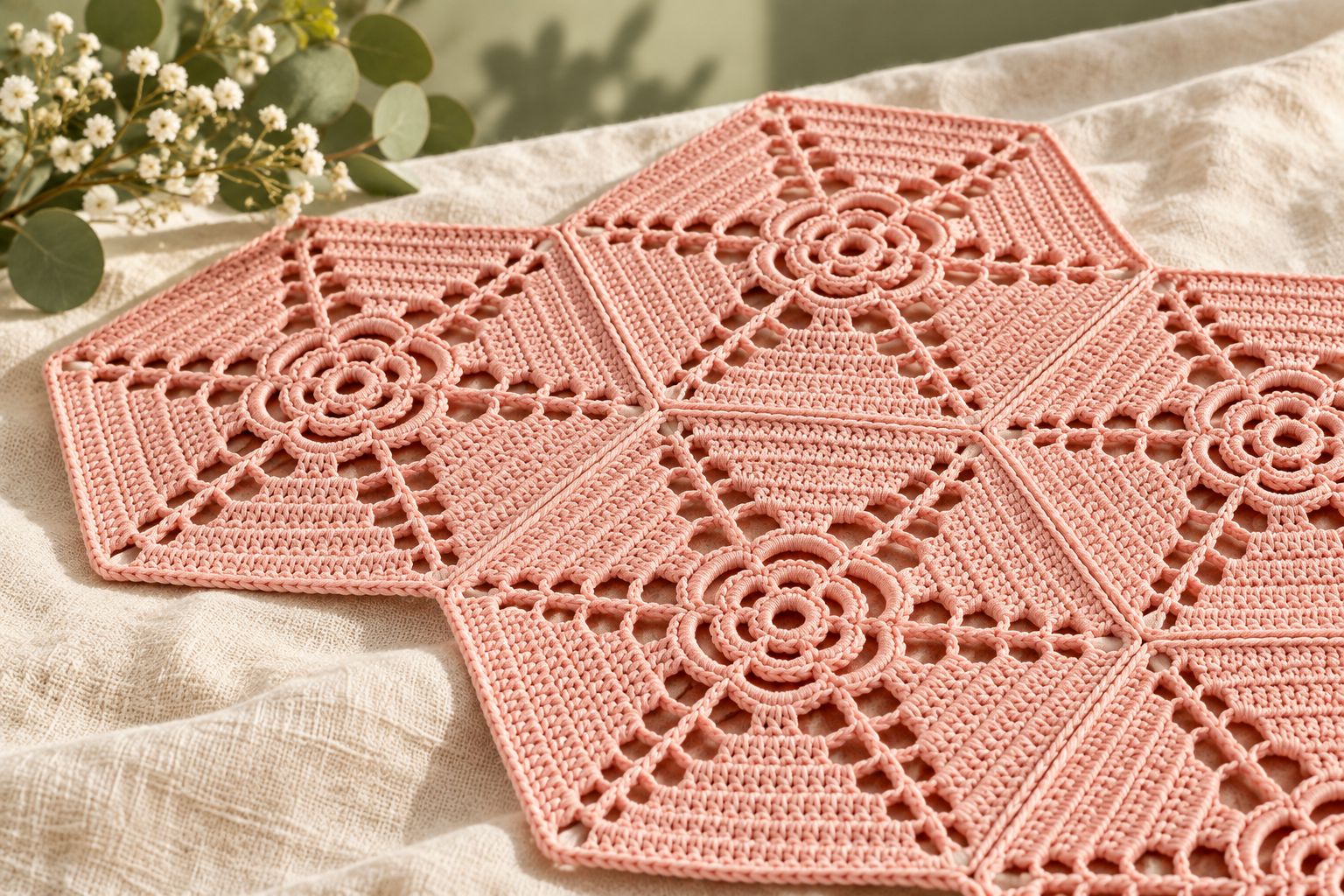
Block all motifs to the same measurements before assembly. Lay them right side up in offset rows, with a consistent orientation. Photograph the layout for your own reference and label the rows. Count stitches along each joining edge; a neat join starts with matching stitch positions, not with pulling a small motif to fit a large one.
For a flexible sewn join, place two motifs right side up with the chosen edges together. Using matching yarn and a blunt needle, whipstitch through corresponding edge loops. Start and finish at equivalent corner positions, secure the tails, and keep the yarn relaxed. Join a short edge first and inspect both sides. If you prefer a slip-stitch seam, test its ridge and flexibility on the sample panel before using it throughout.
At points where three motifs meet, secure the junction neatly without leaving an oversized opening or a tight knot that draws the fabric inward. Work in manageable sections so the weight of the growing cover does not pull on the active seam. Recheck the panel against the bed or paper layout after each section.
✨ Edging, blocking and care
Decide whether to preserve the hexagon outline or design a straighter edge. For a simple finish, work a relaxed sc foundation around the outer boundary. Place stitches consistently along the sides and test increases at outward points and decreases at inward valleys. The correct spacing depends on the motif and join; check a corner section before working the full perimeter.
A narrow plain border can balance a busy floral design. For a shell or scalloped finish, use an edging with a defined repeat and check that its repeat fits your foundation count. Do not add a large decorative edge first and hope blocking will remove ruffles. Lay the work flat frequently and adjust the sample section before continuing.
Follow the yarn label when washing. Support the weight of wet crochet, shape the cover on a clean suitable surface and let it dry thoroughly. Avoid hanging a heavy wet piece by one edge. Store clean and dry, and refold occasionally. Check seams and woven-in tails after the first wash.
🌿 Troubleshooting before you go further
| What you notice | What to check |
|---|---|
| The motif cups inward | Count the corners and dc. Check for skipped stitches, tight chains or inconsistent tension before changing hook size. |
| The edge waves | Look for accidental extra stitches or an oversized corner group. Confirm that each practice-pattern corner is (dc, ch 2, dc). |
| Some motifs are larger | Compare round counts, yarn batches and hooks. Block samples consistently; remake a markedly different motif rather than stretching its neighbors. |
| The seam puckers | Relax the joining yarn and match corresponding loops. Remove and redo a short seam if it pulls the corners inward. |
| The final outline has gaps | Return to the layout. Full hexagons produce an uneven outline; plan partial motifs separately if a straight edge is essential. |
❓ Frequently asked questions
Can I make the exact bedspread shown from this photo?
No exact stitch sequence or reliable gauge can be recovered from the image alone. This article separates design inspiration from a simpler practice pattern. For the pictured level of floral detail, you need a complete floral-lace hexagon pattern and a tested sample.
How many hexagons do I need for a bedspread?
The answer depends on your blocked motif size, joining method, mattress measurements and desired drop. Assemble a small offset panel, measure its actual coverage and map the outline. Count the full and partial motifs in that layout rather than dividing the mattress width by one motif width.
Is a crochet hexagon bedspread suitable for beginners?
The solid practice motif is approachable if you can make dc stitches, count in rounds and recognize chain spaces. A large cover adds repetition and assembly work. Try a small throw or panel first; intricate floral lace is a separate skill step.
Can I use a different yarn weight or color?
Yes, but a different yarn changes gauge, drape, weight and quantity. Make a fresh washed sample. For a tonal blush cover, buy matching dye lots; for a mixed palette, test the seam color before committing.
Can I crochet directly from the two additional images?
No. They are AI-generated illustrations, included to show color, tools and texture. They do not prove stitch counts, physical feasibility or a tested construction. Follow written instructions and verify your own sample.
Keep exploring handmade bedspreads
If you enjoy soft colors and repeating motifs, explore these related projects next. Each guide explains its own inspiration and construction notes.
Browse the full Blankets & Bedspreads collection, or send a pattern question with the round and stitch count you are checking. For this project, begin with one hexagon, then one joined panel. A measured sample will tell you more than a large pile of untested motifs.